

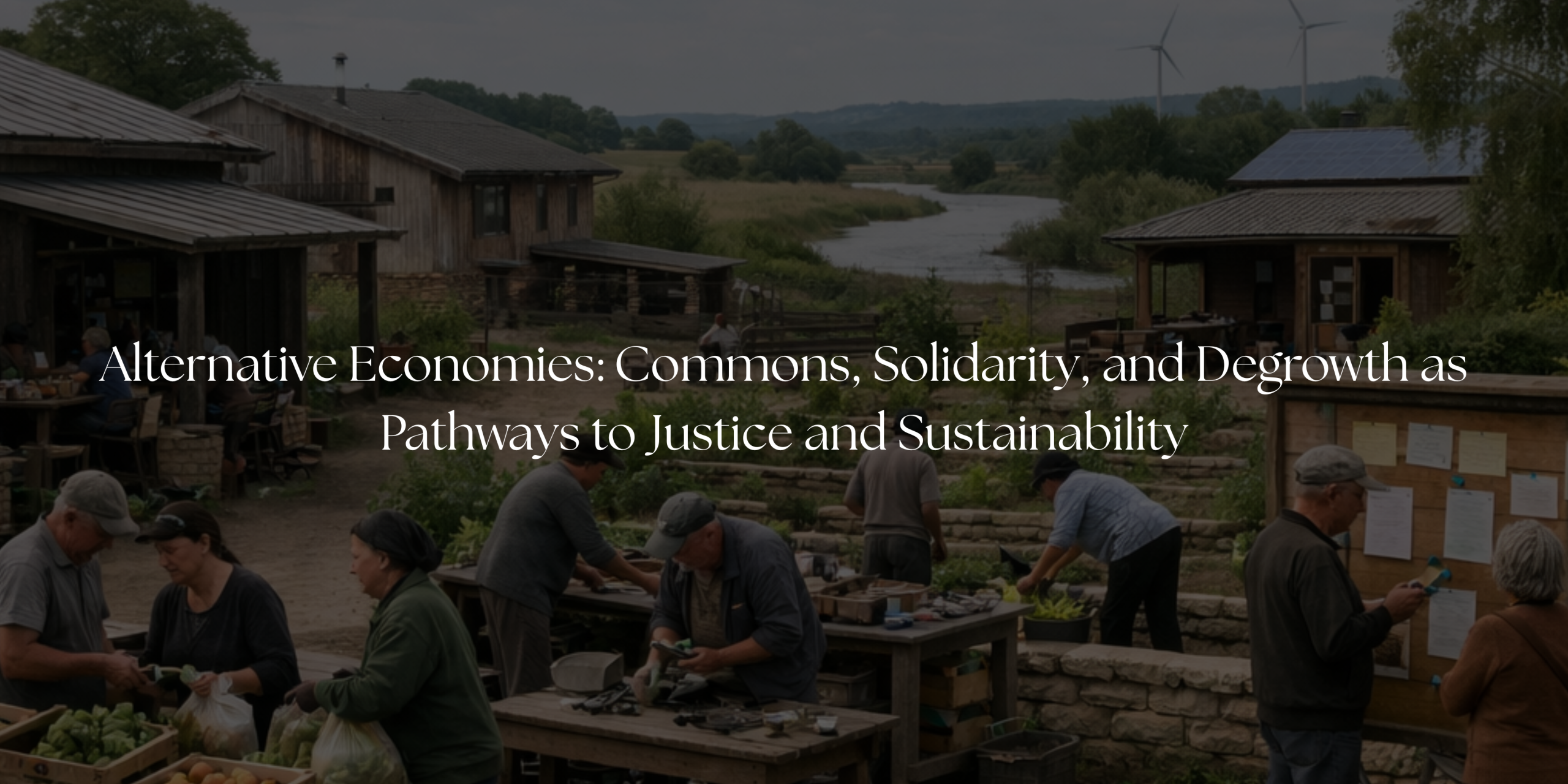
As global crises intensify and inequality deepens, more people are questioning whether traditional economic systems can continue to sustain human and ecological well being. Dominant growth focused models rely on perpetual expansion, competition, and extraction, yet these very forces drive environmental destruction and social division. Burl Minnis, in World Peace, argues that the monetary ideology creates artificial scarcity, suppresses human virtue, and perpetuates the system of all human misery. Against this backdrop, alternative economies grounded in the commons, solidarity, and degrowth are emerging as hopeful pathways that prioritize justice, sustainability, and the flourishing of all life.
Rediscovering the Commons
One of the most powerful ideas gaining renewed attention is the concept of the commons. Historically, the commons referred to shared resources that communities stewarded collectively. These included forests, grazing lands, water sources, and essential tools for survival. Minnis emphasizes that early human societies thrived within frameworks of shared access and communal responsibility. There were no artificial measures of scarcity, no price tags on human rights, and no hierarchy of ownership that placed some lives above others. The commons represented a natural system built on cooperation and trust.
In modern contexts, the commons extend far beyond physical land. Digital commons, knowledge commons, and community maintained infrastructures exemplify the principle that resources can be governed collectively for the good of all. This approach challenges the dominant ideology that treats everything as a commodity to be privatized or monetized. By embracing the commons, societies move closer to an equitable model where value is determined by usefulness rather than profit. This shift aligns with Minnis’s argument that humans prospered for hundreds of thousands of years by sharing rather than hoarding.
Building Communities of Solidarity
The second pillar of alternative economies is solidarity. Solidarity based systems focus on mutual support, collective wellbeing, and the recognition that every individual’s welfare is connected to the welfare of the community. These models reject the isolation and competition that are hallmarks of monetary ideology. Instead, they cultivate trust, empathy, and cooperation.
Cooperatives, community supported agriculture, neighborhood mutual aid networks, and worker owned enterprises embody the values of solidarity. In these systems people are not treated as economic units but as active participants in shared prosperity. They have a voice in decision making and contribute to structures that prioritize relationships over profits.
Minnis argues that solidarity is not an abstract ideal but a natural human inclination suppressed by institutionalized ideology. For most of human history our species relied on cooperation to survive. The re emergence of solidarity based economies reflects a return to our rational and compassionate roots. It signifies a rebuilding of the social fabric that monetary systems have systematically eroded.
The Promise of Degrowth
The third transformative idea is degrowth. While often misunderstood, degrowth is not about shrinking the economy in a destructive manner. Instead, it challenges the assumption that economic growth must be constant and infinite. Degrowth calls for reducing unnecessary production, eliminating wasteful consumption, and focusing on wellbeing rather than profit.
Minnis highlights that the idea of limitless growth is a central flaw in the monetary ideology. A system that demands continuous expansion cannot exist on a finite planet. Degrowth opens the possibility of aligning human activity with ecological limits. It allows societies to shift attention from accumulation to balance, from exploitation to regeneration.
In a degrowth oriented world, success is measured by health, happiness, ecological restoration, and equitable distribution of resources. Communities produce what they need rather than what markets demand. Energy systems prioritize sustainability. Economic activity respects the inherent value of ecosystems instead of treating them as endless reserviors for extraction. These values directly counter the destructive patterns Minnis critiques in the system of all human misery.
Why Alternative Economies Matter Now
The urgency of exploring alternative economies grows with every passing year. Climate change, mass extinction, housing instability, food insecurity, and global inequality are escalating. These crises are not natural. They are outcomes of an economic structure that values profit over life and encourages exploitation at every level.
Minnis argues that the way forward requires abandoning the fiction that money is a legitimate measure of value. When societies cling to this ideology, they ignore ecological limits, moral responsibility, and human rights. Commons, solidarity, and degrowth offer practical, humane alternatives that restore dignity and balance. They allow humanity to function once again as connected beings rather than isolated competitors.
Toward a Flourishing Future
Transitioning to alternative economies is not a utopian vision. It is a necessary evolution grounded in evidence, logic, and the principles that sustained humanity long before the rise of monetary and political ideologies. The commons ensure collective stewardship. Solidarity rebuilds social bonds. Degrowth realigns human activity with ecological reality.
Together these pathways create a foundation for justice, sustainability, and true prosperity. They reflect what Minnis identifies as humanity’s natural state. Rational, cooperative, imaginative, and compassionate. By embracing these models, societies can dismantle structures that perpetuate inequality and environmental degradation. They can build a future that honors both people and planet.
Conclusion
The rise of alternative economies represents more than a critique of existing systems. It offers a hopeful vision of what humanity can achieve when guided by cooperation rather than competition. By revitalizing the commons, strengthening solidarity, and embracing degrowth, communities can create systems rooted in justice, sustainability, and collective flourishing. These principles echo the ancient wisdom that guided human societies for millennia and provide a roadmap for healing the fractures of the modern world.