

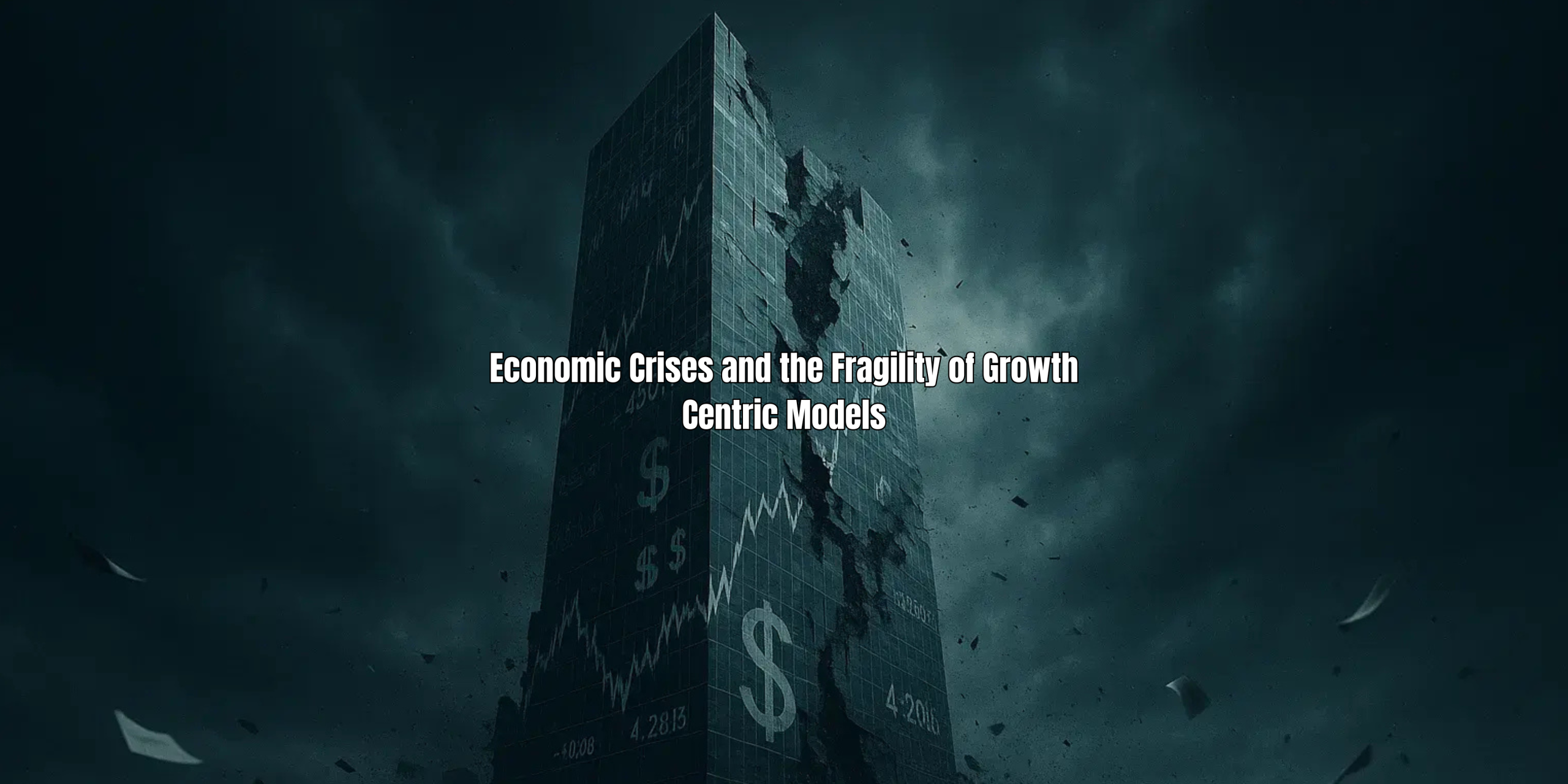
In an era defined by recurring financial instability, global societies continue to rely on growth centric models that promise prosperity but repeatedly expose deep systemic weaknesses. History shows that economic crises are not rare anomalies. They are predictable consequences of systems built on monetary ideology, artificial scarcity, and perpetual expansion. Major downturns, from the Great Depression to the 2008 financial crisis, reveal how fragile these frameworks truly are and why alternative approaches are increasingly necessary. As explored in World Peace by Burl Minnis, the modern economy operates not on natural laws but on collective belief in money as value rather than value itself . When belief falters, the system cracks.
The historical pattern of collapse
Throughout the past century, economic crises have followed a recognizable cycle. Markets inflate through speculation, credit expands beyond real productive capacity, and debt accumulates faster than income. Eventually, confidence evaporates and the system collapses. Each crisis exposes core vulnerabilities that are inherent in growth centric economic systems, particularly their dependence on constant consumption and profit. These downturns are not simply financial disruptions. They illustrate the consequences of prioritizing ideology over reality, a theme deeply rooted in Minnis’s analysis of the monetary economy ideology, which he identifies as the keystone of the broader system of human suffering .
Historical crises show us that economies built on abstraction rather than tangible need become increasingly unstable. Early human societies relied on gifting and barter, which reflected real utility and communal interdependence . By contrast, modern money has no intrinsic value. It functions entirely as a symbolic construct. Because it is disconnected from physical reality, its perceived worth can vanish instantly. When this happens on a national or global scale, the results are catastrophic.
The illusion of endless growth
At the center of every major economic crisis lies a fundamental flaw: the assumption that growth can continue indefinitely. Growth centric models demand expansion regardless of environmental limits, social well being, or actual human need. This creates a permanent state of pressure on markets and resources. When expansion slows, panic reverberates through the system.
As Minnis explains, modern economies are built on commonly agreed upon value rather than empirical utility, and this abstraction invites recurring collapse because it relies on belief rather than reality . The pursuit of constant growth also fosters greed, a psychological malady he argues is created by the monetary system itself. Greed accelerates risk taking, inflates asset bubbles, and ultimately contributes to global financial instability.
Artificial scarcity and structural fragility
A defining feature of most financial crises is the revelation that scarcity is often artificial. There is plenty of food, housing, medicine, and technology in the world. Yet billions lack access because money restricts distribution. Minnis emphasizes that scarcity becomes a tool of ideology. It divides societies into “haves” and “have nots,” reinforcing the fragility of growth focused economies while creating unnecessary human suffering .
During economic downturns, artificial scarcity becomes more visible. Jobs vanish, savings evaporate, and resources are withheld not because they cease to exist, but because the flow of money stops. The system collapses inward, revealing that its foundations are neither natural nor reliable.
Why growth centric models fail
Modern economies rely heavily on debt. Debt requires repayment, which requires growth. When growth cannot keep pace, defaults spread and institutions fail. The fragility of these models stems from this built in dependency. They demand continual expansion even in circumstances where it is impossible or harmful.
Minnis’s work highlights that every economic crisis is a demonstration of the inherent instability caused by confusing fiction with reality. Money and markets are human inventions, yet societies treat them as natural forces that dictate survival. This misalignment leads to massive global consequences, including recession, poverty, conflict, and the erosion of human rights .
The human cost of economic collapse
Financial crises do more than disrupt markets. They impact health, education, housing, and access to essential resources. The human toll is immense. Millions lose employment, millions more fall into poverty, and social inequities widen. These outcomes are not accidents. They are the direct result of systems designed around competition, accumulation, and profit rather than cooperation and well being.
Minnis argues that humans thrived for most of their history without such systems. For over 200,000 years, human societies operated on rational, cooperative modes of survival. Only in the past 13,000 years did organized ideology and monetary systems begin to reshape human behavior through artificial rules that distort natural human tendencies toward collaboration and fairness .
Toward resilience and new possibilities
Given the repeated failures of growth centric models, more scholars, policymakers, and citizens are questioning whether these systems can ever be stable or just. The crises of today are not isolated events. They are manifestations of a deeper structural fragility. Minnis proposes that genuine economic resilience will require rethinking value itself and recognizing money as the ideological fiction that underpins global instability.
Instead of systems that depend on growth, societies can pursue models that prioritize human rights, sustainability, and equitable access to resources. This requires shifting from abstraction to physical reality, from competition to cooperation, and from artificial scarcity to shared prosperity.
Conclusion
Economic crises reveal the truth about modern economies. They show how easily the structures we depend on can fail and how deeply society has anchored itself to systems that are not grounded in reality. Growth centric models may offer temporary gains, but their long term fragility is undeniable. As Minnis argues throughout World Peace, recognizing the fictional nature of monetary ideology is the first step in creating a stable, humane, and sustainable global system .